The Ngorongoro Crater
What is the Ngorongoro Crater?
The Ngorongoro Crater is the remains of a once massive volcano, nearly three million years old, on the eastern border of the Serengeti National Park. Now collapsed and eroded to leave the world's largest unbroken caldera, it forms an extraordinarily fertile ‘bowl’ in the midst of rolling highlands, with permanent water sources and steep sides ensuring that the wildlife that thrives here has little reason to leave.
Situated in the midst of the Ngorongoro Conservation Area, a wildlife preservation area roughtly the size of Crete, the crater forms an important aspect of the northern Tanzania safari circuit.
Ngorongoro Safaris and Wildlife
The crater is the spectactular stalking ground of around 20,000 to 30,000 wild animals at any one time, the most densely packed concentration of wildlife in Africa. The crater thus holds an astonishing microcosm of East African wildlife within its boundaries, and thus has achieved renown as 'the eighth wonder of the world', and attracts a growing number of visitors each year.
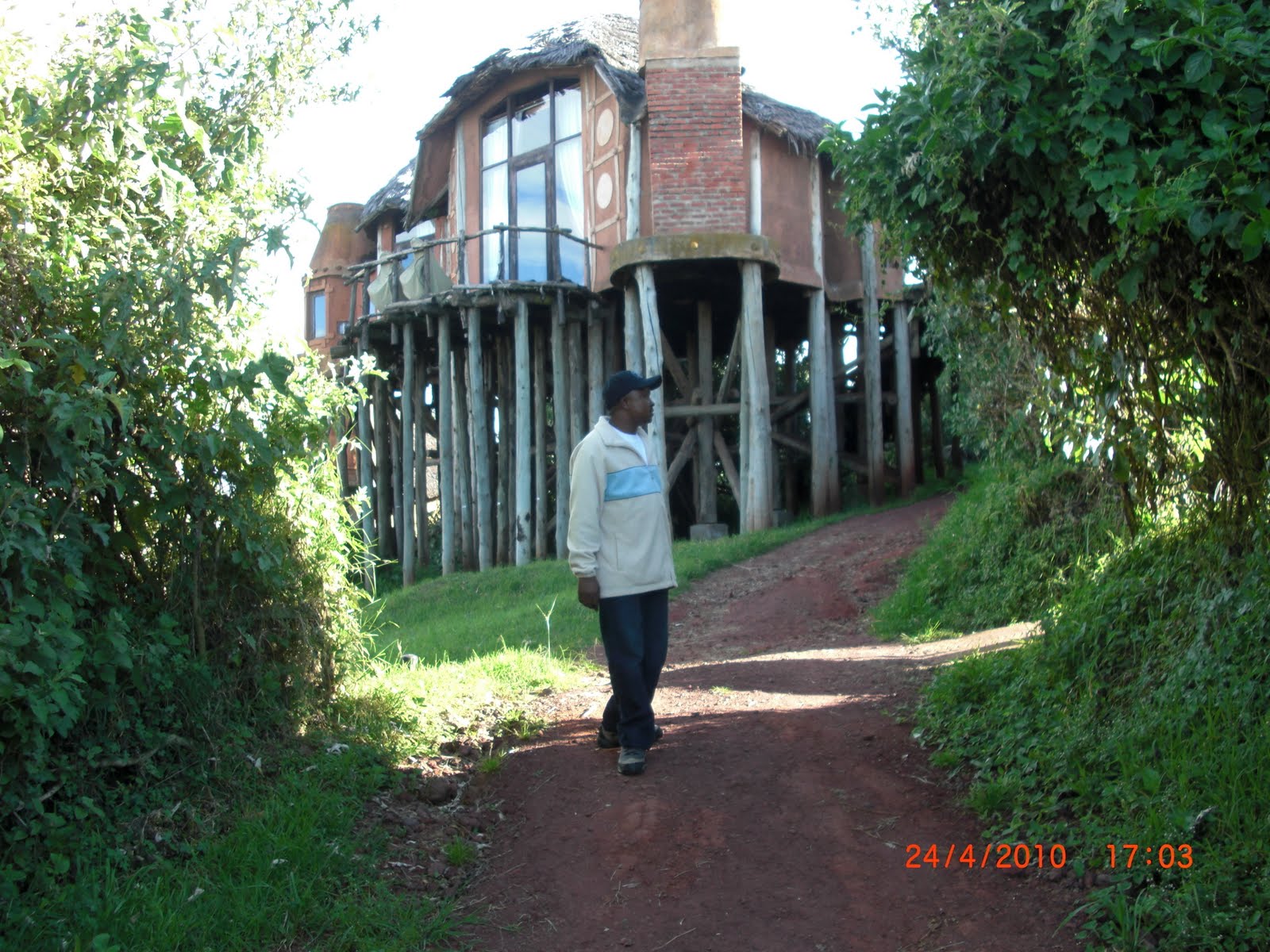
VIEW OF NGORONGORO CRATER LODGE SITUATED AT THE CRATER VIEW
In order to preserve the quality of the experience and the environment, measures have had to be taken to limit the number of people inside the crater at any one time, and safaris are now limited to one per day for each vehicle either as a morning or an afternoon trip. It remains a rewarding safari location, even when time is limited.
Ngorongoro Crater Habitats and Highlights
VIEW OF NGORONGORO CRATER SAFARI SHOP PRODUCTS
The Crater comprises areas of grassland, swamps, lerai forest (small patches of forest made up of yellow-barked acacia and yellow fever trees), and Lake Makat, a central soda lake filled by the Munge river.
These habitats attract all kinds of wildlife to drink, wallow, graze or hide, and although the animals are free to move in and out of this contained environment, the rich volcanic soil, lush forests and spring-fed lakes on the crater floor incline both grazers and predators to remain.
A VIEW OF NGORONGORO CRATER
Ngorongoro Crater is one of the last remaining areas in Tanzania where you are likely to see the endangered Black Rhino: a small population is thriving in this idyllic and protected environment, and it remains one of the few areas where they continue to breed in the wild.
EFTA LTD
MIKOPO YA MASHINE BILA DHAMANA
SMS & EMAIL MARKETING
CALL FOR SERVICES 0762 461 460
TANAKI TOURS AND SAFARIS
EQUIPMENT LOAN WITHOUT COLLATERAL
CHOOSE YOU CATEGORY OF CHOICE HERE.
Wednesday, April 28, 2010
Tarangire National Park
Tarangire National Park has some of the highest population density of elephants anywhere in Tanzania, and its sparse vegetation, strewn with baobab and acacia trees, makes it a beautiful and special location. Located just a few hours drive from the town of Arusha, Tarangire is a popular stop for safaris travelling through the northern circuit on their way to Ngorongoro and the Serengeti. The park extends into two game controlled areas and the wildlife are allowed to move freely throughout.
Before the rains, droves of gazelle, wildebeest, zebra, and giraffes migrate to Tarangire National Park’s scrub plains where the last grazing land still remains. Tarangire offers unparalleled game viewing, and during the dry season elephants abound. Families of the pachyderms play around the ancient trunks of baobab trees and strip acacia bark from the thorn trees for their afternoon meal. Breathtaking views of the Masaai Steppe and the mountains to the south make a stop at Tarangire a memorable experience.
Ngorongoro Crater- The pride of Tanzania
Ngorongoro Crater
The Ngorongoro Crater is often called ‘Africa’s Eden’ and the ‘8th Natural Wonder of the World,’ a visit to the crater is a main drawcard for tourists coming to Tanzania and a definite world-class attraction. Within the crater rim, large herds of zebra and wildebeest graze nearby while sleeping lions laze in the sun. At dawn, the endangered black rhino returns to the thick cover of the crater forests after grazing on dew-laden grass in the morning mist. Just outside the crater’s ridge, tall Masaai herd their cattle and goats over green pastures through the highland slopes, living alongside the wildlife as they have for centuries.
Ngorongoro Conservation Area includes its eponymous famous crater, Olduvai Gorge, and huge expanses of highland plains, scrub bush, and forests that cover approximately 8300 square kilometres. A protected area, only indigenous tribes such as the Masaai are allowed to live within its borders. Lake Ndutu and Masek, both alkaline soda lakes are home to rich game populations, as well as a series of peaks and volcanoes and make the Conservation Area a unique and beautiful landscape. Of course, the crater itself, actually a type of collapsed volcano called a caldera, is the main attraction. Accommodation is located on its ridges and after a beautiful descent down the crater rim, passing lush rain forest and thick vegetation, the flora opens to grassy plains throughout the crater floor. The game viewing is truly incredible, and the topography and views of the surrounding Crater Highlands out of this world.
This truly magical place is home to Olduvai Gorge, where the Leakeys discovered the hominoid remains of a 1.8 million year old skeleton of Australopithecus boisei, one of the distinct links of the human evolutionary chain. In a small canyon just north of the crater, the Leakeys and their team of international archaeologists unearthed the ruins of at least three distinct hominoid species, and also came upon a complete series of hominoid footprints estimated to be over 3.7 million years old. Evacuated fossils show that the area is one of the oldest sites of hominoid habitation in the world.
The Ngorongoro Crater and the Ngorongoro Conservation Area are without a doubt some of the most beautiful parts of Tanzania, steeped in history and teeming with wildlife. Besides vehicle safaris to Ngorongoro Crater, Olduvai Gorge, and surrounding attractions, hiking treks through the Ngorongoro Conservation Area are becoming increasingly popular options. Either way you choose to visit, the Crater Highlands are an unforgettable part of the Tanzanian experience.
The Ngorongoro Crater is often called ‘Africa’s Eden’ and the ‘8th Natural Wonder of the World,’ a visit to the crater is a main drawcard for tourists coming to Tanzania and a definite world-class attraction. Within the crater rim, large herds of zebra and wildebeest graze nearby while sleeping lions laze in the sun. At dawn, the endangered black rhino returns to the thick cover of the crater forests after grazing on dew-laden grass in the morning mist. Just outside the crater’s ridge, tall Masaai herd their cattle and goats over green pastures through the highland slopes, living alongside the wildlife as they have for centuries.
Ngorongoro Conservation Area includes its eponymous famous crater, Olduvai Gorge, and huge expanses of highland plains, scrub bush, and forests that cover approximately 8300 square kilometres. A protected area, only indigenous tribes such as the Masaai are allowed to live within its borders. Lake Ndutu and Masek, both alkaline soda lakes are home to rich game populations, as well as a series of peaks and volcanoes and make the Conservation Area a unique and beautiful landscape. Of course, the crater itself, actually a type of collapsed volcano called a caldera, is the main attraction. Accommodation is located on its ridges and after a beautiful descent down the crater rim, passing lush rain forest and thick vegetation, the flora opens to grassy plains throughout the crater floor. The game viewing is truly incredible, and the topography and views of the surrounding Crater Highlands out of this world.
This truly magical place is home to Olduvai Gorge, where the Leakeys discovered the hominoid remains of a 1.8 million year old skeleton of Australopithecus boisei, one of the distinct links of the human evolutionary chain. In a small canyon just north of the crater, the Leakeys and their team of international archaeologists unearthed the ruins of at least three distinct hominoid species, and also came upon a complete series of hominoid footprints estimated to be over 3.7 million years old. Evacuated fossils show that the area is one of the oldest sites of hominoid habitation in the world.
The Ngorongoro Crater and the Ngorongoro Conservation Area are without a doubt some of the most beautiful parts of Tanzania, steeped in history and teeming with wildlife. Besides vehicle safaris to Ngorongoro Crater, Olduvai Gorge, and surrounding attractions, hiking treks through the Ngorongoro Conservation Area are becoming increasingly popular options. Either way you choose to visit, the Crater Highlands are an unforgettable part of the Tanzanian experience.
Saturday, April 24, 2010
ABOUT TANZANIA
United Republic of Tanzania
Jamhuri ya Muungano wa Tanzania
Flag Coat of arms
Motto: "Uhuru na Umoja" (Swahili)
"Freedom and Unity"
Anthem: Mungu ibariki Afrika
"God Bless Africa"
Capital Dodoma
Largest city Dar es Salaam
Official language(s) Swahili (de facto)
English (Higher courts, higher education)[1]
Demonym Tanzanian
Government Republic
- President Jakaya Kikwete
- Prime Minister Mizengo Pinda
Independence from the United Kingdom
- Tanganyika 9 December 1961
- Zanzibar 12 January 1964
- Merger 26 April 1964
Area
- Total 945,203 km2 (31th)
364,898 sq mi
- Water (%) 6.2
Population
- 2009 estimate 43,739,000[2] (32nd)
- 2005 census 37,445,392
- Density 46.3/km2 (124th)
119.9/sq mi
GDP (PPP) 2009 estimate
- Total $57.400 billion[3]
- Per capita $1,416[3]
GDP (nominal) 2009 estimate
- Total $22.318 billion[3]
- Per capita $550[3]
Gini (2000–01) 34.6 (medium)
HDI (2008) ▲ 0.530 (medium) (151st)
Currency Tanzanian shilling (TZS)
Time zone EAT (UTC+3)
- Summer (DST) not observed (UTC+3)
Drives on the left
Internet TLD .tz
Calling code +2552
1 Estimates for this country explicitly take into account the effects of excess mortality due to AIDS; this can result in lower life expectancy, higher infant mortality and death rates, lower population and growth rates, and changes in the distribution of population by age and sex than would otherwise be expected.
² 007 from Kenya and Uganda.
Coordinates: 6°18′25″S 34°51′14″E / 6.307°S 34.854°E / -6.307; 34.854 The United Republic of Tanzania (pronounced /ˌtænzəˈniːə/; Swahili: Jamhuri ya Muungano wa Tanzania)[4] is a nation in central East Africa bordered by Kenya and Uganda to the north, Rwanda, Burundi and the Democratic Republic of the Congo to the west, and Zambia, Malawi and Mozambique to the south. The country's eastern borders lie on the Indian Ocean.
The United Republic of Tanzania is a unitary republic composed of 26 mikoa (regions).[5] The current head of state is President Jakaya Mrisho Kikwete, elected in 2005. Since 1996, the official capital of Tanzania has been Dodoma, where parliament and some government offices are located. Between independence and 1996 the major coastal city of Dar es Salaam had been the country's political capital. Today Dar es Salaam remains the principal commercial city of Tanzania and the de-facto seat of most government institutions.It is the major seaport for the country and its landlocked neighbours.
The name Tanzania is a portmanteau of Tanganyika and Zanzibar. The two states united in 1964 to form the United Republic of Tanganyika and Zanzibar, which later the same year was renamed the United Republic of Tanzania.[5]
Jamhuri ya Muungano wa Tanzania
Flag Coat of arms
Motto: "Uhuru na Umoja" (Swahili)
"Freedom and Unity"
Anthem: Mungu ibariki Afrika
"God Bless Africa"
Capital Dodoma
Largest city Dar es Salaam
Official language(s) Swahili (de facto)
English (Higher courts, higher education)[1]
Demonym Tanzanian
Government Republic
- President Jakaya Kikwete
- Prime Minister Mizengo Pinda
Independence from the United Kingdom
- Tanganyika 9 December 1961
- Zanzibar 12 January 1964
- Merger 26 April 1964
Area
- Total 945,203 km2 (31th)
364,898 sq mi
- Water (%) 6.2
Population
- 2009 estimate 43,739,000[2] (32nd)
- 2005 census 37,445,392
- Density 46.3/km2 (124th)
119.9/sq mi
GDP (PPP) 2009 estimate
- Total $57.400 billion[3]
- Per capita $1,416[3]
GDP (nominal) 2009 estimate
- Total $22.318 billion[3]
- Per capita $550[3]
Gini (2000–01) 34.6 (medium)
HDI (2008) ▲ 0.530 (medium) (151st)
Currency Tanzanian shilling (TZS)
Time zone EAT (UTC+3)
- Summer (DST) not observed (UTC+3)
Drives on the left
Internet TLD .tz
Calling code +2552
1 Estimates for this country explicitly take into account the effects of excess mortality due to AIDS; this can result in lower life expectancy, higher infant mortality and death rates, lower population and growth rates, and changes in the distribution of population by age and sex than would otherwise be expected.
² 007 from Kenya and Uganda.
Coordinates: 6°18′25″S 34°51′14″E / 6.307°S 34.854°E / -6.307; 34.854 The United Republic of Tanzania (pronounced /ˌtænzəˈniːə/; Swahili: Jamhuri ya Muungano wa Tanzania)[4] is a nation in central East Africa bordered by Kenya and Uganda to the north, Rwanda, Burundi and the Democratic Republic of the Congo to the west, and Zambia, Malawi and Mozambique to the south. The country's eastern borders lie on the Indian Ocean.
The United Republic of Tanzania is a unitary republic composed of 26 mikoa (regions).[5] The current head of state is President Jakaya Mrisho Kikwete, elected in 2005. Since 1996, the official capital of Tanzania has been Dodoma, where parliament and some government offices are located. Between independence and 1996 the major coastal city of Dar es Salaam had been the country's political capital. Today Dar es Salaam remains the principal commercial city of Tanzania and the de-facto seat of most government institutions.It is the major seaport for the country and its landlocked neighbours.
The name Tanzania is a portmanteau of Tanganyika and Zanzibar. The two states united in 1964 to form the United Republic of Tanganyika and Zanzibar, which later the same year was renamed the United Republic of Tanzania.[5]
Subscribe to:
Posts (Atom)
